






Bill Higher Than Expected? Insurance Giant Refuses to Pay for the Dali
Source:CNSS
2026-07-03
US insurance giant Chubb has refused to pay its assessed share of the $2.25 billion settlement for the collapse of the Baltimore Bridge. Sources say that after Chubb refused to pay its share (believed to be less than $250 million), the Protection and Indemnity Club covering the shipowner was forced to fill the gap. According to Chubb, the final bill for the incident came to approximately $2.8 billion, unexpectedly exceeding the initial estimate of $1.5 billion.
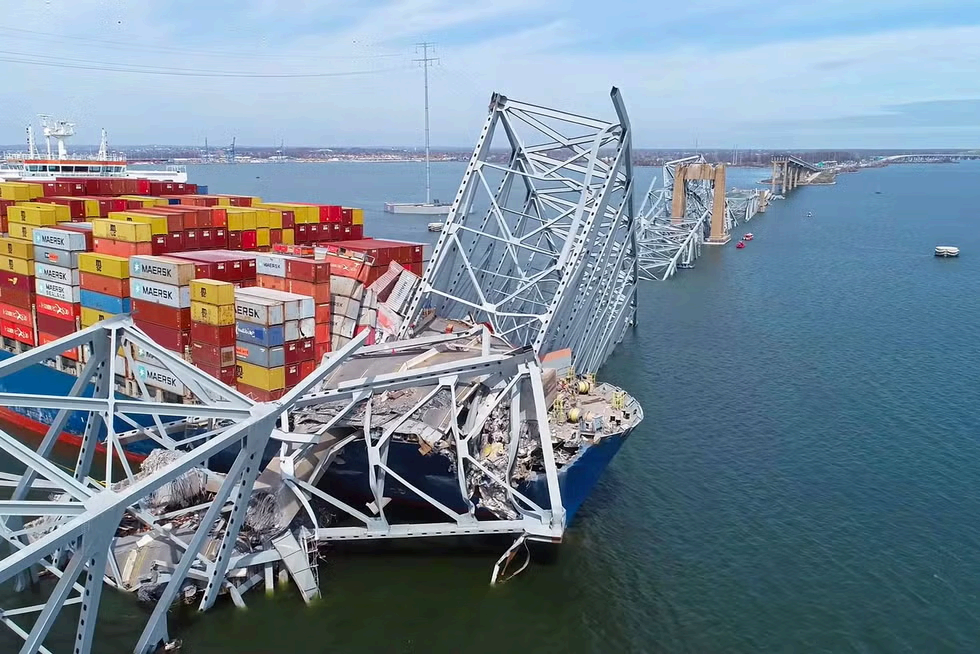
In March 2024, a power outage caused failures in the propulsion and steering systems of the container ship Dali, which struck and destroyed the Francis Scott Key Bridge in Baltimore. Photo credit: National Transportation Safety Board (NTSB).
The settlement amount of $2.25 billion is the largest single compensation payment arising from the collapse of the Baltimore Bridge in March 2024. The incident was caused when the containership Dali lost propulsion and steering due to an electrical fault, striking the bridge and causing its partial collapse—at a time when some lanes of the bridge were closed for resurfacing. Six construction workers on the bridge lost their lives.
The incident triggered two years of legal proceedings. Most civil claims have now been resolved. Other personnel are currently on standby, awaiting the outcome of criminal charges brought against the vessel's managers, chief engineer, and shore-based supervisors.
The International Group of P&I Clubs, comprising twelve member clubs, views this refusal to pay negatively.
One market source commented: "They [Chubb] are trying to exploit a loophole, hoping to settle the matter at a lower cost... Their claim of not being informed about the specific amount of the settlement could simply be disproved by reading the newspaper. It is fair to say the entire industry is uneasy about Chubb's conduct."
Under a risk-sharing mechanism dating back nearly 130 years, for any single incident the insuring P&I Club (in this case, Britannia P&I Club) pays the first $10 million of third-party damages. Thereafter, the member clubs of the International Group of P&I Clubs collectively share the excess up to $100 million. All losses exceeding that level are covered by annual contracts the International Group enters into with dozens of reinsurers, with a single-event limit of $3.1 billion for major casualties.
These reinsurers are very rarely called upon to pay claims. However, the Dali incident has set a new record for the largest single maritime loss in shipping history, far exceeding the $1.6 billion loss from the Costa Concordia disaster in 2012, which claimed 32 lives.
According to a market outlook report published last month by (re)insurance group BMS, Chubb also provided cover for the Francis Scott Key Bridge itself, with a $350 million policy paid out shortly after the bridge collapsed.
BMS stated that the initial $1.5 billion estimate had informed reinsurance pricing decisions by the International Group and the reserves that individual clubs anticipated holding. "The increase in the deal to $2.8 billion radically shifts the focus of discussions," wrote Joshua Robertson, BMS Director of North American Marine.
"No single reinsurer would directly absorb the full $2.8 billion loss—it is spread across dozens of reinsurance contracts and ultimately borne by hundreds of capital providers. That is the structural strength of the system—it was designed to absorb losses of this magnitude without requiring any single reinsurer to exit the market," he stated.
Hot News