






World's Highest Load-Bearing Capacity! Ultimate Load Test on the Stern Ramp of Jiangsu Jinling's First WW9300 Series Vessel Successfully Completed
Source:China Merchants Jinling Shipbuilding
2026-06-29
On June 27, the ultimate load test on the stern ramp of the first vessel in the Jiangsu Jinling WW9300 series was successfully completed. Under a full load condition of 530 tonnes, the ramp structure remained intact and all performance indicators fully met the required standards, marking the successful completion of the load test on the world's highest load-bearing capacity RoRo vessel stern ramp and accelerating delivery of subsequent high-quality vessels in the series.
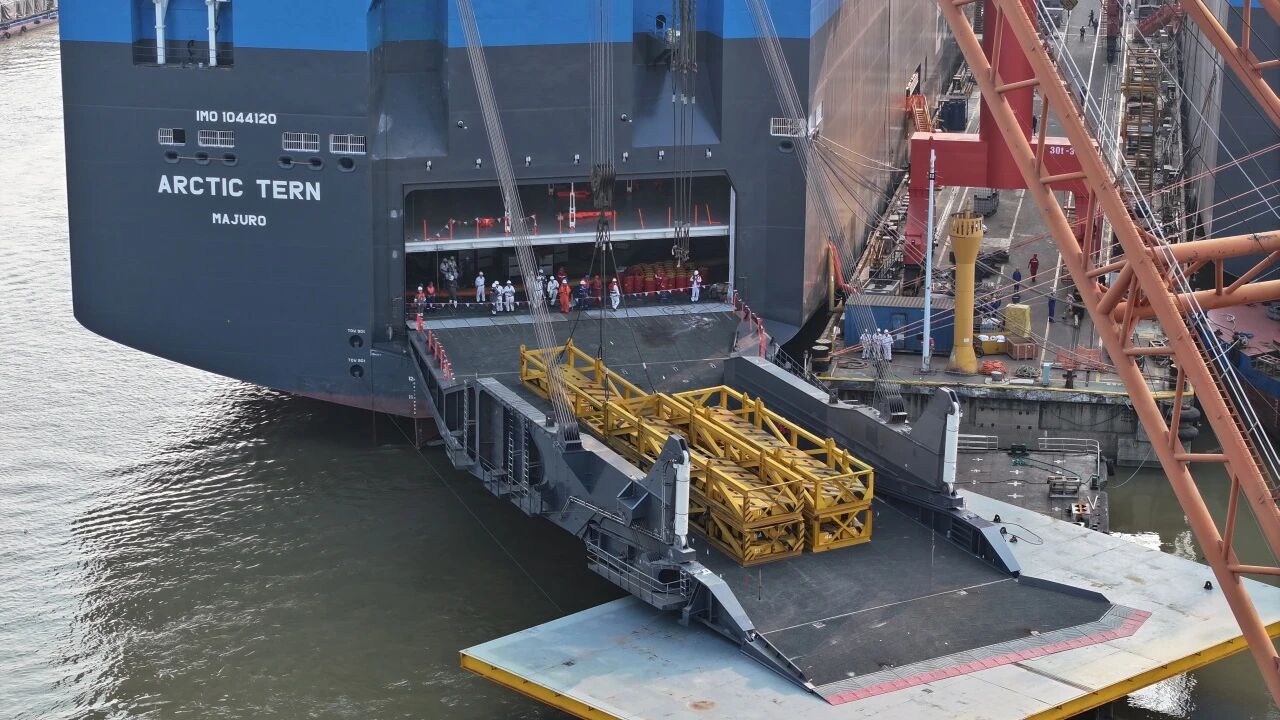
The stern ramp serves as the core loading and unloading hub for pure car and truck carriers, and its structural strength directly determines both the operational ceiling and the safety baseline of the vessel. This test was designed to address the load characteristics of an ultra-large stern ramp and innovatively employed a linked test configuration involving the main vessel and two barges, with extreme working conditions serving as the design control benchmark throughout.
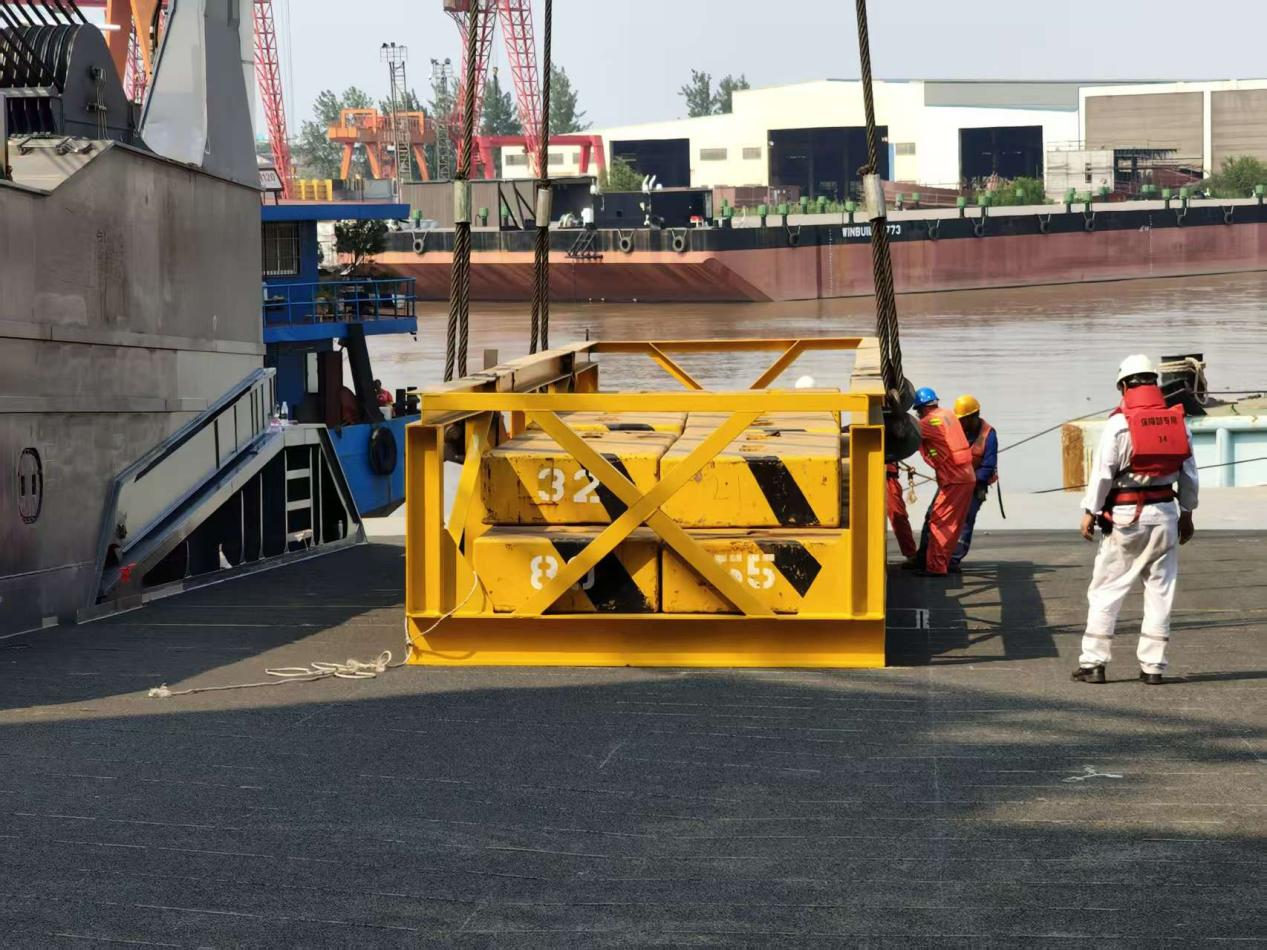
The project team systematically completed the overall planning of the barge loading and tooling arrangement in the preparatory phase, implementing targeted structural reinforcement at the concentrated stress points of the hinges. Strength verification simultaneously covered both normal wire rope loading and failure scenarios under extreme conditions, with a design upper limit based on a 500.3-tonne barge deck load. Concurrently, full-process floating state pre-calculations and tooling height compatibility assessments were completed ahead of time, supported by the deployment of high-precision levelling monitoring equipment, embedding risk management comprehensively into the test preparation stage and guaranteeing the scientific rigour and safety of the test programme from the outset.
On-site operations proceeded strictly in accordance with the principle of "progressive verification with full-process control." After the vessel and barges were secured with multiple moorings and the support tooling was rigidly fixed, the stern ramp was smoothly landed onto the barge at the designated angle. The loading procedure was formally initiated following joint verification and sign-off by the design centre, the shipowner, and the classification society.
The loading process was conducted methodically in two stages: after an initial 300-tonne counterweight load was applied and the structural strength re-verified, the self-tensioning function was activated to incrementally apply the remaining load in three sequential batches, ultimately reaching the target test load of 530 tonnes with precision. Throughout the test, dynamic floating state calculations for the vessel and barges were synchronised, together with real-time verification of the tooling and hull structure. Complete data records were retained and confirmed by multiple parties at every loading stage, ensuring the process remained safe and controlled. The test also received strong support from the maritime authorities, with a maritime patrol vessel providing full-time tracking and monitoring throughout, establishing a secure outer perimeter for the waterside operations.
After the static hold period under full load was complete and the entire load had been removed, a comprehensive inspection revealed no defects, such as structural tearing or permanent plastic deformation, in the ramp body. Its overall performance fully satisfied both specification and design requirements.
The success of this test not only fully validated the reliability and stability of the WW9300 series stern ramp system, but also established a comprehensive technical framework for the testing of ultra-heavy-load RoRo equipment. This provides a replicable technical template for the construction of subsequent vessels in the series, further consolidates Jiangsu Jinling's technical competitiveness in the construction of large PCTCs, and injects strong momentum into the upgrading of the enterprise's high-end shipbuilding capabilities.
Hot News